 |
 |
 |
 |
 |
 |
 |
 |
 |
 |
 |
 |
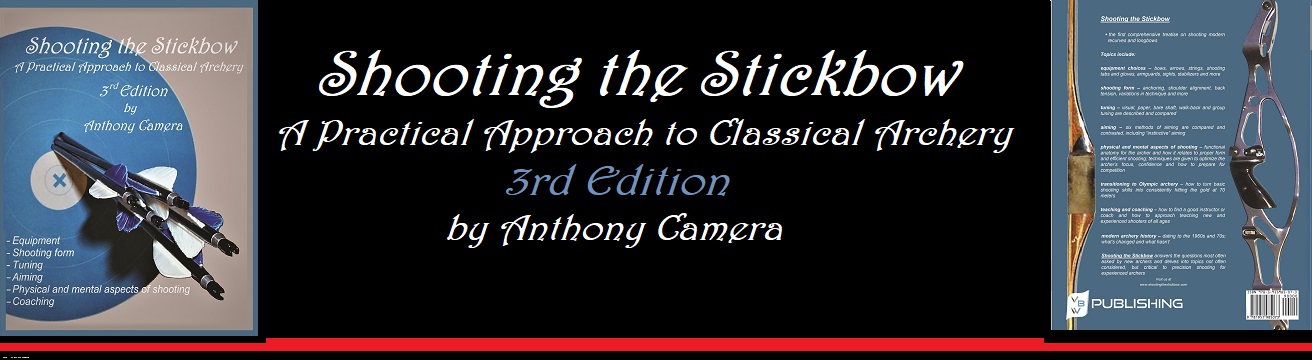
Shooting the Stickbow is written in four parts.
Part 1 Basics of Shooting the Stickbow
Chapter 1 Equipment Fundamentals
Chapter 2 Basic Equipment Setup
Chapter 3 Elementary Shooting Form
Chapter 4 Common Errors and How to Correct Them
Chapter 5 Tuning the Bow and Arrow – The First Steps
Chapter 6 Tuning the Bow and Arrow – Beyond the Basics
Chapter 7 Transitioning to Olympic Style Shooting
Part one contains information for the new archer on what to look for in buying a first bow, arrows and necessary accessories followed by detailed instructions on how to set up the equipment for efficient and safe use. A chapter is devoted to common errors, their causes and how to correct them. The section concludes with three chapters on tuning the equipment for optimal performance. The first tuning chapter presents the five techniques to tune a bow. The next chapters explain the Physics behind bow tuning and arrow dynamics and the last chapter fully explains Olympic style tuning, and teaches the archer how to go from traditional archery to hitting the gold at 70 meters.
Part 2 Equipment – A Detailed View
Chapter 8 Bow Design – Building a Virtual Bow
Chapter 9 Arrows
Chapter 10 Fletching, the Art of Building an Arrow
Chapter 11 Bowstrings
Part two departs from the techniques of shooting and explores the design and construction theories of "stickbows" beginning with a simple 2x4 piece of lumber and gradually morphing it into a full blown target bow and finally a compound bow with cables and pulleys. Various design features are examined and their functions are explained. The next chapters look at arrow design and the materials used in their construction. The pros and cons of each material are explained. A chapter is devoted to arrow building and decorating. This section concludes with a chapter on bowstrings. As with previous sections, the materials and construction methods are clearly shown and the reader is taught to build two types of bowstrings.
Part 3 Making the Shot – Theories and Practice
Chapter 12 Aiming
Chapter 13 Back Tension, Breathing and Related Topics
Chapter 14 Variations in Technique
Chapter 15 Physical Fitness
Chapter 16 Archery – the Mental Game
Chapter 17 Teaching and Coaching
Part three is the heart of Shooting the Stickbow. For the first time, an explanation of the various aiming methods is presented in clear and precise terms. Each method blends into the next or more advanced methods, giving the archer several avenues, to not only find the best method for him, but to extend his shooting range and ability. Following the aiming chapter, the reader is given a practical understanding of back tension and breathing during the shot sequence. Exercises are given to enhance the archer’s understanding and performance of these processes. The next two chapters provide an in-depth analysis of both the physical and mental aspects of the game. This section concludes with a separate chapter on teaching and coaching.
Part 4 Memories and Musings
Chapter 18 The Golden Age of Archery
Chapter 19 The Life and Legacy of Earl Hoyt Jr. The Father of Modern Olympic Archery
Part four begins with an historical perspective on the "Golden Age of Archery", the 1960’s and 70’s and extends to include some current offerings. It covers what has changed and more importantly, what hasn't. There is a review of the major production bows (and arrows) of the era, as well as a section on buying and restoring vintage bows. The last chapter is devoted to Earl Hoyt Jr. Earl, who more than any other bowyer / manufacturer, set the standard for the modern recurve bow. A timeline of Hoyt Archery is included from 1938 to present.
Appendices
Appendix A Math, measurements and standards
Appendix B Bowstring and arrow references
Appendix C Resources
Appendix D Frequently Asked Questions
Appendix E Glossary
Appendices include math, measurements, resources and standards for archers and an arrow and bowstring reference guide.
About the author –
In the summer of 1968 the author was 11 years of age and as luck would have it, he saw The Adventures of Robin Hood with Errol Flynn on television one Saturday afternoon. Something clicked, and later that year he acquired a solid fiberglass bow (Stemmler Archery, 30 pounds), three wooden arrows and related archery accessories by selling Christmas cards to family, friends and neighbors. Without any formal training, the three arrows didn’t last very long, especially since he was shooting into a concrete garage; this was Brooklyn after all, not exactly the wide open spaces. Happily, several sporting goods stores in the area carried archery equipment, and “kid’s” arrows weren’t that expensive, so replenishment wasn’t too difficult. By the next year he was able to purchase a “real” laminated recurve bow, well, an entry-level semi-recurve anyway (Indian Archery, Cochise, 40 pounds). Weather permitting, archery practice was every day after school and almost all day, every day, during the summer months. This continued for a few years, and with no signs of losing interest, he finally had the bright idea to ask one of the sporting goods store owners whether there were any archery ranges in the area. Yes, it took him nearly four years to think of that. He convinced his father to drive him to the range one very snowy night. (The Comanche Bowmen Inc. Archery Club in the Bay Ridge section of Brooklyn, about five miles from his house.) His father wasn’t happy about driving to an archery range in near blizzard conditions, but the kid was determined. One look at the place, and he was hooked! He soon after joined the club as a junior member and made the half-hour bus trip two, sometimes three, times a week. With proper instruction, his skill developed and he began competing in the adult classes at age 16. Thereafter he became the youngest Range Officer the club had to date, and began teaching with the club’s JOAD (Junior Olympic Archery Development) program, and instructed local Scout troops and the PAL (Police Athletic League) members that regularly used the range. Thereafter, he began building arrows and bow strings and was competing at state and regional levels with an NFAA “AA” barebow (without the use of bow sights) rating. He became one of the range’s senior range officers and a certified New York State Bowhunting Safety Instructor. He also gave archery demonstrations in the 1970s and 80s at the New York Renaissance Faire (as Robin Hood, of course) and did trick shooting on several television shows.
After being a successful instinctive archer and bowhunter for years he took a small hiatus from archery in the late 1980s and early 90s to learn rifle marksmanship, achieving Masters’ ratings in both International and Conventional Hi-Power styles of rifle shooting. The two disciplines (archery and rifle marksmanship) worked well together, and a lot of lessons learned from one were easily transferred to the other. In the late 1990s, his enthusiasm for target archery resurfaced. He resurrected some vintage target bows from his collection, and over several years regained his previous skill levels.
The next logical step was to transition to a modern Olympic style bow. The challenges and rewards of precision shooting at longer distances continued and that has been the author’s main area of interest since the beginning of this century. He has run indoor and outdoor matches and has continued to teach numerous students, many of whom competed at national levels.
The author completed his undergraduate studies at New York University, with a BA in Biology and continued his graduate studies there in Physiology. That knowledge helped him to understand the mechanics of shooting and the processes of many of the theories presented in this book. Although no longer competing, he shoots three to four times a week at local ranges and has moderated an archery forum on the Internet. After 50 years in the sport, he says, “It’s nice to be able to relax at the range, shoot and maybe pass along some of the things I’ve learned over the years to others.”
Part 1 Basics of Shooting the Stickbow
Chapter 1 Equipment Fundamentals
Chapter 2 Basic Equipment Setup
Chapter 3 Elementary Shooting Form
Chapter 4 Common Errors and How to Correct Them
Chapter 5 Tuning the Bow and Arrow – The First Steps
Chapter 6 Tuning the Bow and Arrow – Beyond the Basics
Chapter 7 Transitioning to Olympic Style Shooting
Part one contains information for the new archer on what to look for in buying a first bow, arrows and necessary accessories followed by detailed instructions on how to set up the equipment for efficient and safe use. A chapter is devoted to common errors, their causes and how to correct them. The section concludes with three chapters on tuning the equipment for optimal performance. The first tuning chapter presents the five techniques to tune a bow. The next chapters explain the Physics behind bow tuning and arrow dynamics and the last chapter fully explains Olympic style tuning, and teaches the archer how to go from traditional archery to hitting the gold at 70 meters.
Part 2 Equipment – A Detailed View
Chapter 8 Bow Design – Building a Virtual Bow
Chapter 9 Arrows
Chapter 10 Fletching, the Art of Building an Arrow
Chapter 11 Bowstrings
Part two departs from the techniques of shooting and explores the design and construction theories of "stickbows" beginning with a simple 2x4 piece of lumber and gradually morphing it into a full blown target bow and finally a compound bow with cables and pulleys. Various design features are examined and their functions are explained. The next chapters look at arrow design and the materials used in their construction. The pros and cons of each material are explained. A chapter is devoted to arrow building and decorating. This section concludes with a chapter on bowstrings. As with previous sections, the materials and construction methods are clearly shown and the reader is taught to build two types of bowstrings.
Part 3 Making the Shot – Theories and Practice
Chapter 12 Aiming
Chapter 13 Back Tension, Breathing and Related Topics
Chapter 14 Variations in Technique
Chapter 15 Physical Fitness
Chapter 16 Archery – the Mental Game
Chapter 17 Teaching and Coaching
Part three is the heart of Shooting the Stickbow. For the first time, an explanation of the various aiming methods is presented in clear and precise terms. Each method blends into the next or more advanced methods, giving the archer several avenues, to not only find the best method for him, but to extend his shooting range and ability. Following the aiming chapter, the reader is given a practical understanding of back tension and breathing during the shot sequence. Exercises are given to enhance the archer’s understanding and performance of these processes. The next two chapters provide an in-depth analysis of both the physical and mental aspects of the game. This section concludes with a separate chapter on teaching and coaching.
Part 4 Memories and Musings
Chapter 18 The Golden Age of Archery
Chapter 19 The Life and Legacy of Earl Hoyt Jr. The Father of Modern Olympic Archery
Part four begins with an historical perspective on the "Golden Age of Archery", the 1960’s and 70’s and extends to include some current offerings. It covers what has changed and more importantly, what hasn't. There is a review of the major production bows (and arrows) of the era, as well as a section on buying and restoring vintage bows. The last chapter is devoted to Earl Hoyt Jr. Earl, who more than any other bowyer / manufacturer, set the standard for the modern recurve bow. A timeline of Hoyt Archery is included from 1938 to present.
Appendices
Appendix A Math, measurements and standards
Appendix B Bowstring and arrow references
Appendix C Resources
Appendix D Frequently Asked Questions
Appendix E Glossary
Appendices include math, measurements, resources and standards for archers and an arrow and bowstring reference guide.
About the author –
In the summer of 1968 the author was 11 years of age and as luck would have it, he saw The Adventures of Robin Hood with Errol Flynn on television one Saturday afternoon. Something clicked, and later that year he acquired a solid fiberglass bow (Stemmler Archery, 30 pounds), three wooden arrows and related archery accessories by selling Christmas cards to family, friends and neighbors. Without any formal training, the three arrows didn’t last very long, especially since he was shooting into a concrete garage; this was Brooklyn after all, not exactly the wide open spaces. Happily, several sporting goods stores in the area carried archery equipment, and “kid’s” arrows weren’t that expensive, so replenishment wasn’t too difficult. By the next year he was able to purchase a “real” laminated recurve bow, well, an entry-level semi-recurve anyway (Indian Archery, Cochise, 40 pounds). Weather permitting, archery practice was every day after school and almost all day, every day, during the summer months. This continued for a few years, and with no signs of losing interest, he finally had the bright idea to ask one of the sporting goods store owners whether there were any archery ranges in the area. Yes, it took him nearly four years to think of that. He convinced his father to drive him to the range one very snowy night. (The Comanche Bowmen Inc. Archery Club in the Bay Ridge section of Brooklyn, about five miles from his house.) His father wasn’t happy about driving to an archery range in near blizzard conditions, but the kid was determined. One look at the place, and he was hooked! He soon after joined the club as a junior member and made the half-hour bus trip two, sometimes three, times a week. With proper instruction, his skill developed and he began competing in the adult classes at age 16. Thereafter he became the youngest Range Officer the club had to date, and began teaching with the club’s JOAD (Junior Olympic Archery Development) program, and instructed local Scout troops and the PAL (Police Athletic League) members that regularly used the range. Thereafter, he began building arrows and bow strings and was competing at state and regional levels with an NFAA “AA” barebow (without the use of bow sights) rating. He became one of the range’s senior range officers and a certified New York State Bowhunting Safety Instructor. He also gave archery demonstrations in the 1970s and 80s at the New York Renaissance Faire (as Robin Hood, of course) and did trick shooting on several television shows.
After being a successful instinctive archer and bowhunter for years he took a small hiatus from archery in the late 1980s and early 90s to learn rifle marksmanship, achieving Masters’ ratings in both International and Conventional Hi-Power styles of rifle shooting. The two disciplines (archery and rifle marksmanship) worked well together, and a lot of lessons learned from one were easily transferred to the other. In the late 1990s, his enthusiasm for target archery resurfaced. He resurrected some vintage target bows from his collection, and over several years regained his previous skill levels.
The next logical step was to transition to a modern Olympic style bow. The challenges and rewards of precision shooting at longer distances continued and that has been the author’s main area of interest since the beginning of this century. He has run indoor and outdoor matches and has continued to teach numerous students, many of whom competed at national levels.
The author completed his undergraduate studies at New York University, with a BA in Biology and continued his graduate studies there in Physiology. That knowledge helped him to understand the mechanics of shooting and the processes of many of the theories presented in this book. Although no longer competing, he shoots three to four times a week at local ranges and has moderated an archery forum on the Internet. After 50 years in the sport, he says, “It’s nice to be able to relax at the range, shoot and maybe pass along some of the things I’ve learned over the years to others.”